
Since 2015, Mediterranean Exchange of Archaeological Tourism and Archeo have decided to pay homage to archaeological discoveries with an annual prize awarded in collaboration with the international magazines that are media partners of the Exchange: Antike Welt (Germany), arCHaeo (Switzerland), AiD Archäologie in Deutschland (Germany), Archéologia (France), Current and World Archaeology (United Kingdom), Dossiers d’Archéologie (France).
From its first edition until 2024, the award has been named after “Khaled al-Asaad”, Director of the archaeological site and museum of Palmyra from 1963 to 2003, who paid with his life for defending cultural heritage.
After ten years, the award is now named after “Palmyra” in memory of both the hashtag ‘#Unite4HeritageforPalmyra’ – symbol of the BMTA’s 2016 communication campaign to draw attention to the archaeological site for its reconstruction and accompany the rebirth of cultural tourism in Syria – and the twinning agreement signed with Paestum in 2018.
In memory of Khaled al-Asaad
The remembrance of the archaeologist Paolo Matthiae: «For forty years, Khaled al-Asaad has been the Director of the archaeological excavations of Palmyra. He was the archaeologist of the city, he worked with missions from every country: from France to Germany, from Switzerland to Netherlands, from United States to Poland, and in the last years from Italy too, with the mission from Università Statale of Milan. He was a complete scholar, but mostly he had the peculiar feature of a member of the families of the cities of the desert. These people, like the ancient Bedouins, are lovely, kind and very hospitable, in a completely natural way, not excessive but very measured and discreet fashion. Khaled al-Asaad was a very lovely man, measured and with a kind soul. Even archaeologists who didn’t specialize in that period – Roman antiquity – often came to Palmyra to visit him and Khaled’s friendliness was total. He was a man deeply rooted in the city, and yet, for the international character of the site he oversaw, he was a citizen of the world, too. In various occasions his name was suggested for the position of General Director of Antiquities in Damascus, but I believed he preferred to remain in Palmyra, a city he identified himself with».
«Khaled was so certain he was just doing his job that he didn’t think he needed to escape. And as I remember him, he wasn’t a man who feared for his own life. Even if in retirement and almost 82, he preferred to stay in his city, precisely because he had understood its antiquities were in ranger. And probably, he imagined his undisputed moral authority could protect what Palmyra held and still holds today: the ruins of an absolutely extraordinary archaeological site, for all the Mediterranean area and for the whole world».
The International Archaeological Discovery Award ‘Palmyra’ is the only global award dedicated to archaeologists who, with sacrifice, dedication, expertise and scientific research, carry out their daily work in their dual role as scholars of the past and professionals serving the local area.
The Director of the Exchange, Ugo Picarelli, and the Director of Archeo, Andreas Steiner, have shared this journey together, aware that ‘the civilisations and cultures of the past and their relationship with the surrounding environment are becoming increasingly important today in terms of rediscovering identities in a global society that is increasingly losing its values’. The Award, therefore, is characterised by the dissemination of an exchange of experiences, represented by international discoveries, also as a good practice of intercultural dialogue.
The Award, presented to the top-ranked archaeological discovery, will be selected from the five finalists nominated by each participating publication and will be presented on Friday 30 October, during the 28th edition of BMTA, taking place in Paestum from Thursday 29 October to Sunday 1 November 2026.
In addition, a “Special Award” will be presented to the discovery, among the five candidates, that receives the greatest public support between 11 September and 15 October on the Facebook page of the Fair (www.facebook.com/borsamediterraneaturismoarcheologico).
The five archaeological discoveries of 2025 shortlisted as finalists for the 12th edition of the International Archaeological Discovery Award “Palmyra” are:
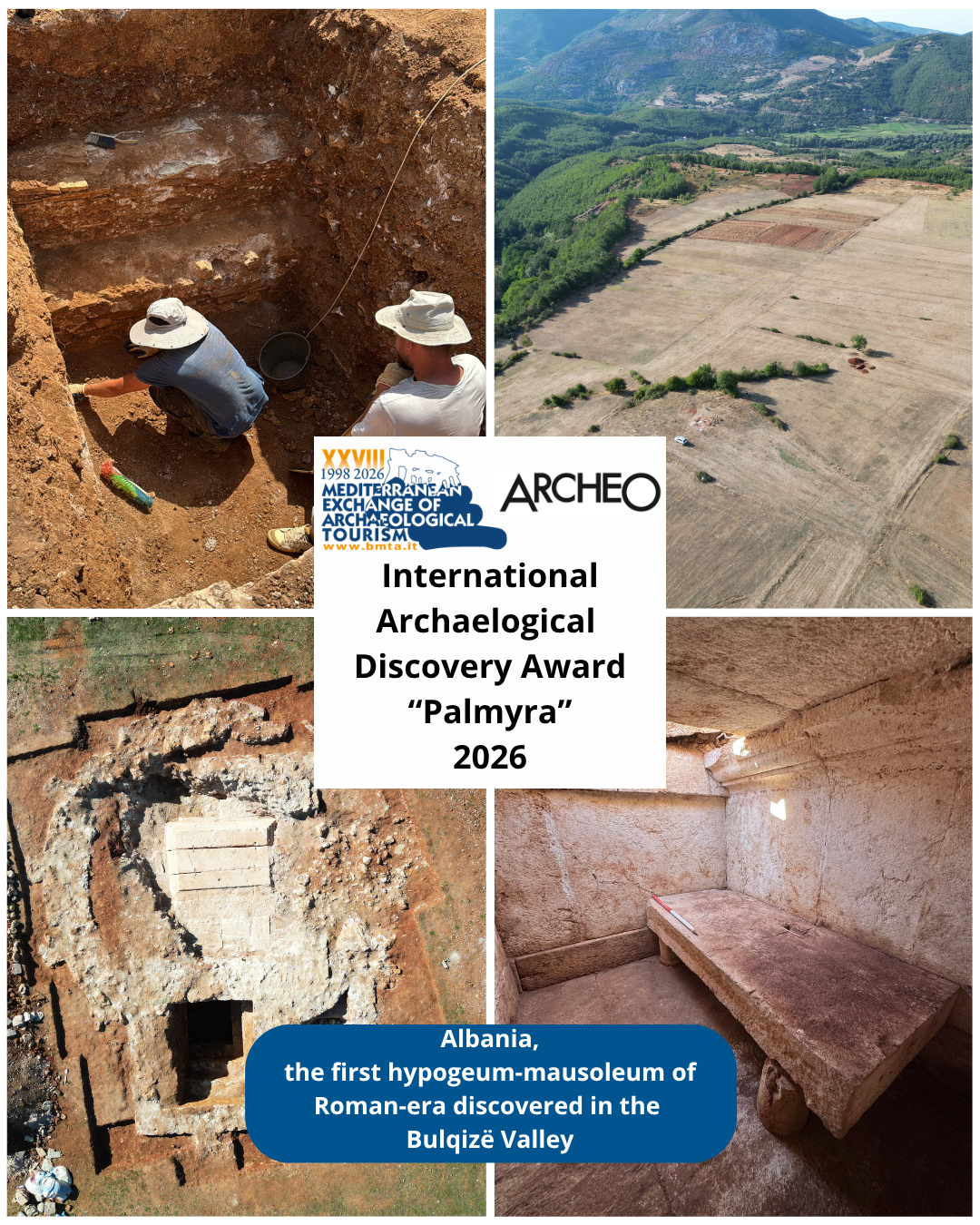
- Albania: the country’s first Roman-period hypogeum-mausoleum discovered in the Bulqizë Valley;
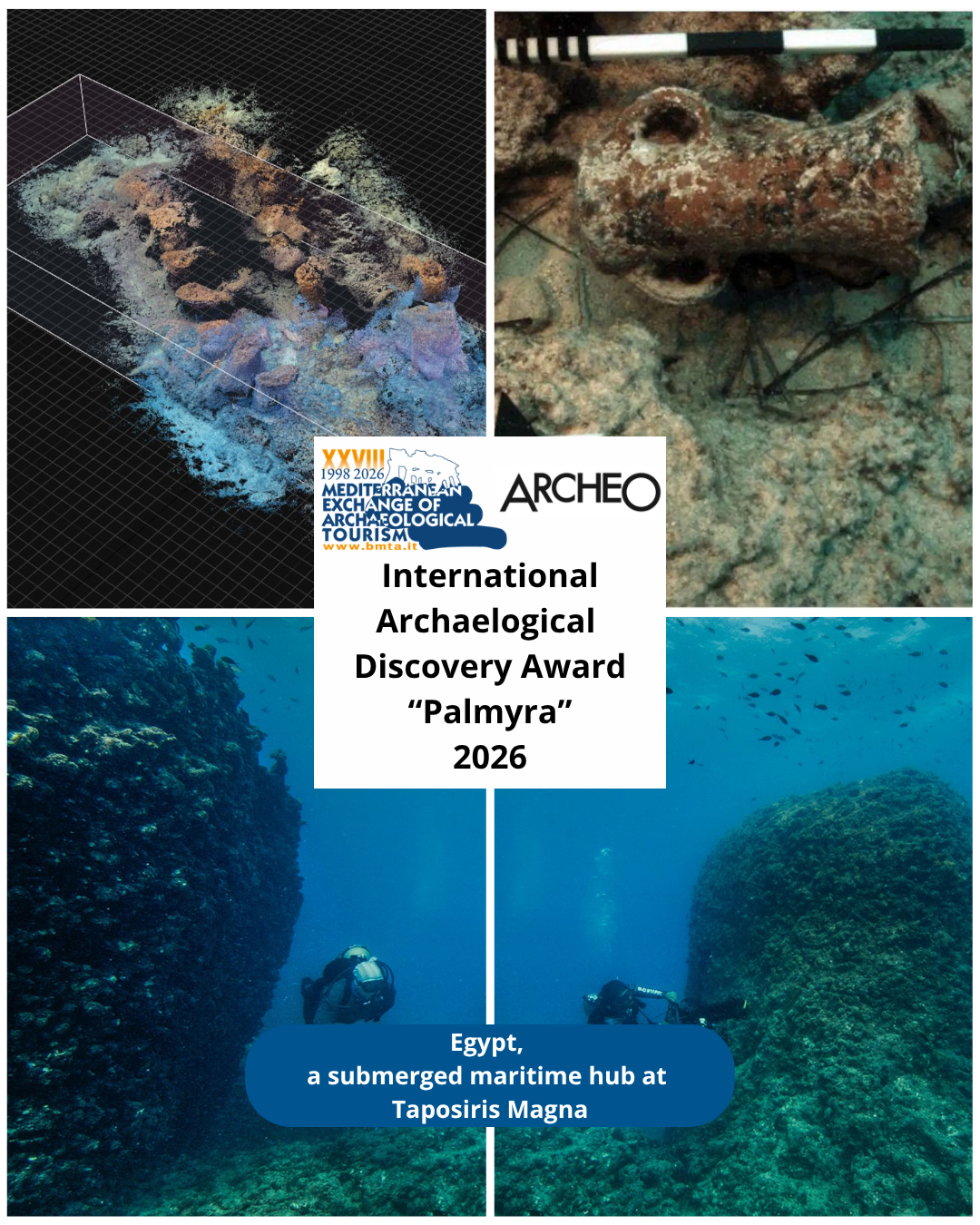
- Egypt: an underwater harbour discovered at Taposiris Magna;
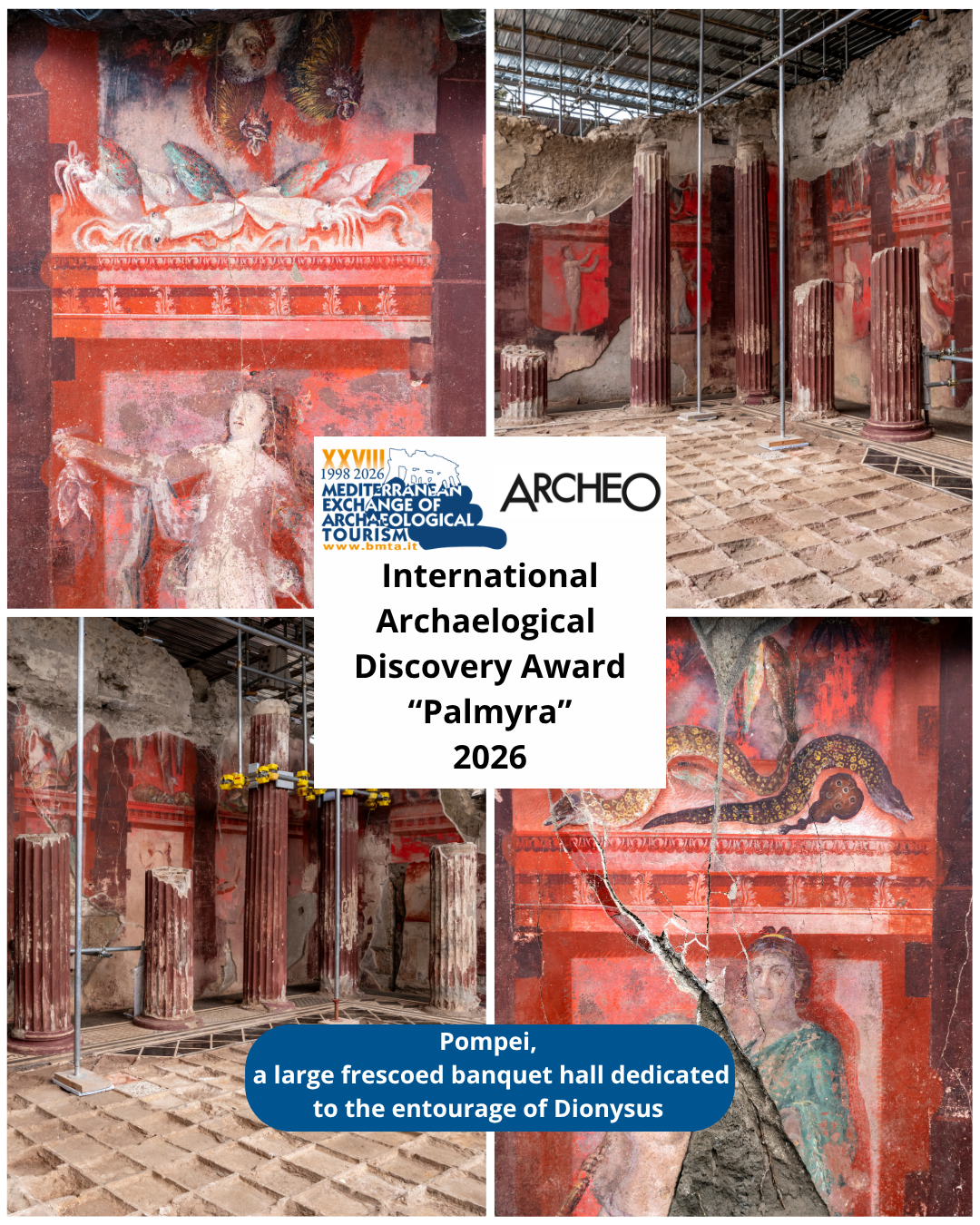
- Italy, Pompeii: a large frescoed banqueting hall dedicated to the procession of Dionysus;
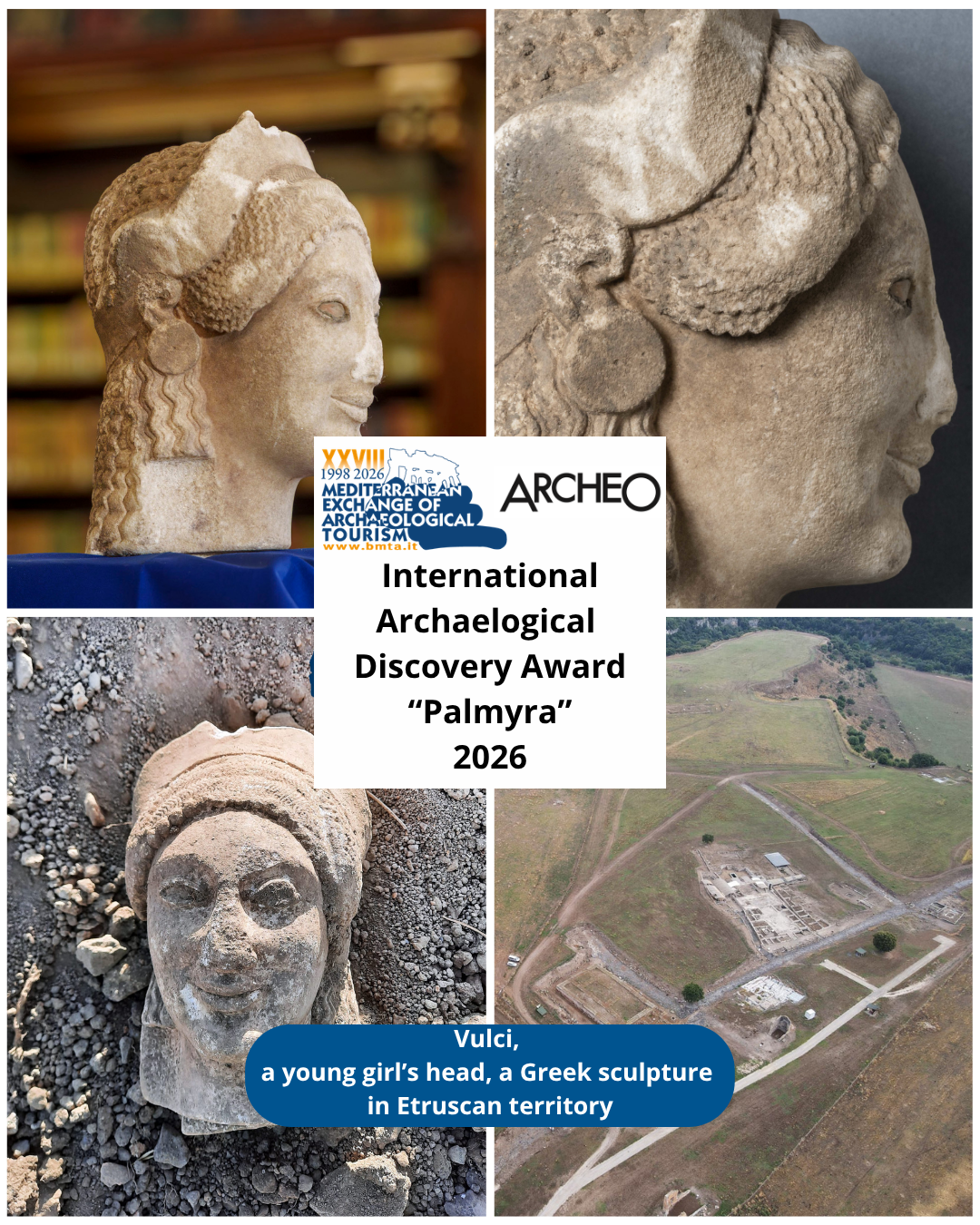
- Italy, Vulci: a girl’s head, a Greek sculpture found in Etruscan territory;
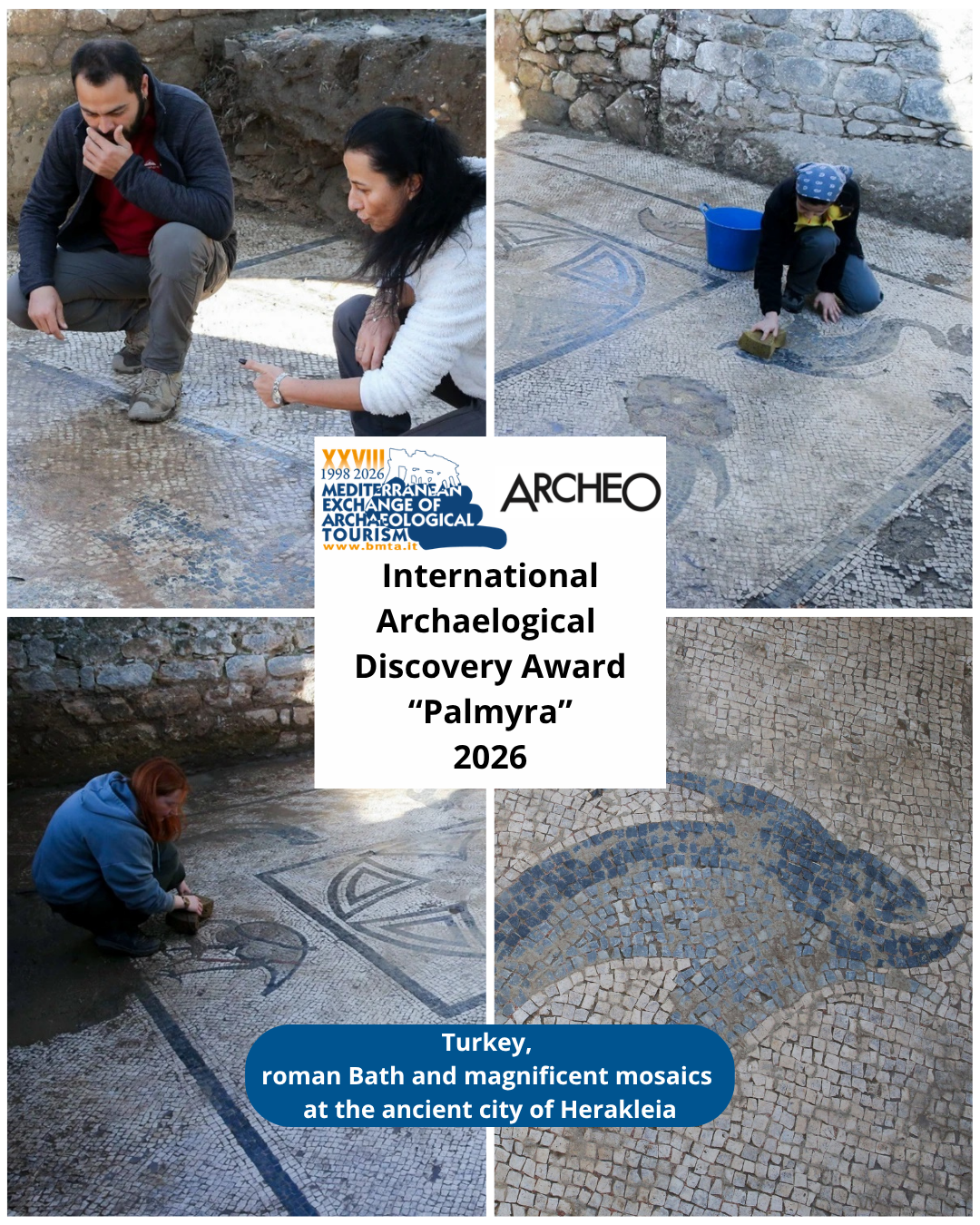
- Türkiye: mosaics depicting crocodiles and flamingos at Heraclea at Latmus.
The discoveries in detail
Albania: the country’s first Roman-period hypogeum-mausoleum discovered in the Bulqizë Valley
In the Bulqizë Valley in Albania, archaeologists have unearthed a large Roman mausoleum dating from between the 3rd and 4th centuries AD. It is the first discovery of its kind in the country, which was part of the Roman Empire for more than six centuries and is now revealing tangible traces of its past. The mausoleum was discovered in the village of Strikcan, in northern Albania, 90 km from Tirana. It is distinguished by the presence of rare architectural and epigraphic elements, including a bilingual inscription dedicated to the person buried there, Gellianus, and to the god Jupiter. The funerary monument, comprising three rooms and preceded by a monumental staircase, is of considerable size, measuring approximately 9 by 6 metres, and contains a 2.4-metre-high burial chamber. Among the grave goods found inside are glass vessels, bone artefacts, weapons and textile fragments woven with gold threads, indicating the high social status of the deceased.
Egypt: a submerged harbour at Taposiris Magna
Archaeologist Kathleen Martínez and renowned Titanic discoverer Bob Ballard have uncovered a submerged complex near the ruins of Taposiris Magna, 50 km west of Alexandria. The discovery is considered a potentially crucial development in solving the mystery surrounding the tomb of Cleopatra VII of Egypt, dating back 2,000 years. The team believes that the discovery of amphorae, several anchors, a polished floor and imposing columns has revealed an ancient lost harbour off the coast of Taposiris Magna. Divers led by Bob Ballard, National Geographic Explorer, mapped polished floors, imposing columns and anchors beneath the surface of the sea. The discovery sheds new light on Taposiris Magna as an important maritime as well as religious centre. According to Martínez, the find strengthens the hypothesis that Cleopatra chose this location for her tomb. Only further research will determine whether her remains lie somewhere off the coast.
Italy, Pompeii: a large frescoed banqueting hall depicting the procession of Dionysus
At Pompeii, excavations in Insula 10 of Regio IX have revealed a large banqueting hall. The walls feature a monumental frieze with almost life-size figures, known as a megalography. The decoration depicts a lively Dionysian procession. The fourth wall of the room opened onto a garden, integrating the space with the surrounding natural environment.
The scene depicts the procession of Dionysus, god of wine: maenads, portrayed both as dancers and fierce huntresses, carry a slaughtered kid goat on their shoulders, or hold a sword and the entrails of an animal in their hands. Young satyrs with pointed ears play the double flute, while another pours wine backwards. A fascinating feature of the frieze is that all the figures are depicted on pedestals, as though they were statues; yet, through their dynamic gestures, skin tones and rendering of the fabrics, they appear remarkably alive and in motion.
Archaeologists have named the dwelling the House of the Thiasus, referring to the festive procession of the god Dionysus. The fresco belongs to the Second Style of Pompeian painting, dating to the 1st century BC, more precisely to between 40 and 30 BC. By the time of the eruption of Mount Vesuvius in AD 79, the frieze was therefore already around a century old. The only other known example of a megalography depicting Dionysian mystery rites is the celebrated frieze of the Villa of the Mysteries, located just outside Pompeii and likewise decorated in the Second Style.
Italy, Vulci: a young woman’s head, a Greek sculpture in Etruscan territory
At Vulci, a Greek marble head of a young woman, a Kore, has been discovered during excavations carried out as part of the “Vulci Cityscape” project, promoted by the Universities of Freiburg and Mainz in collaboration with the Superintendency for Archaeology, Fine Arts and Landscape for the Province of Viterbo and Southern Etruria, together with the Vulci Foundation. Launched in 2020, the project investigates the urban planning and development of the Etruscan city.
The work represents a rare example of Greek sculpture found in Etruscan territory, providing significant insights into the intensity of cultural relations between Greece and pre-Roman Italy. The sculpture depicts a young female figure with an elaborate and sophisticated hairstyle, attributable to an Attic workshop of the early 5th century BC.
The discovery was made in the area of the large new temple uncovered in 2021, further expanding the picture currently known of the religious buildings constructed within the urban centre.
Türkiye: mosaics depicting crocodiles and flamingos at Heraclea at Latmus
Archaeologists from Selçuk University have discovered mosaics depicting animals including crocodiles, dolphins, flamingos and eels, providing new insights into the representation of animals in antiquity. The discovery adds to our knowledge of the art and daily life of the ancient Greek city of Ionia, situated on the slopes of Mount Latmus in what is now Türkiye, in Muğla Province, Milas District.
The excavation, led by archaeologist Zeliha Gider Büyüközer, professor in the Department of Archaeology at Selçuk University, focused on the Roman baths of the ancient city as part of the “Geleceğe Miras” (Heritage for the Future) project of the Turkish Ministry of Culture and Tourism. Büyüközer highlighted that the mosaics uncovered in the frigidarium, the section of the baths used for cold-water bathing, feature depictions of crocodiles, including six crocodile figures facing one another. However, as the area is not particularly suited to crocodile life, the craftsman who created the mosaics may have been a travelling master.
Archive past editions
International Archaeological Discovery Award “Khaled al-Asaad” 2015 (1st edition)
International Archaeological Discovery Award “Khaled al-Asaad” 2016 (2nd edition)
International Archaeological Discovery Award “Khaled al-Asaad” 2017 (3rd edition)
International Archaeological Discovery Award “Khaled al-Asaad” 2018 (4th edition)
International Archaeological Discovery Award “Khaled al-Asaad” 2019 (5th edition)
International Archaeological Discovery Award “Khaled al-Asaad” 2020 (6th edition)
International Archaeological Discovery Award “Khaled al-Asaad” 2021 (7th edition)
International Archaeological Discovery Award “Khaled al-Asaad” 2022 (8th edition)
International Archaeological Discovery Award “Khaled al-Asaad” 2023 (9th edition)
International Archaeological Discovery Award “Khaled al-Asaad” 2024 (10th edition)
International Archaeological Discovery Award “Khaled al-Asaad” 2025 (11th edition)

